Aluminium Window Price in Pakistan: What to Know Before You Compare Per Square Foot Rates
 Nasir MahmoodFounder & Developer, Aluminium Master
Are you planning aluminium windows for your home or a commercial project, and collecting per square foot rates from different shops? Before you compare those numbers, it helps to understand how aluminium windows are made and how their price is worked out.
Most people search online for rates or ask a shopkeeper one simple question: “What is your per square foot rate?” The trouble is that aluminium windows have no single fixed price. A window is not a ready-made, standard product. It is built to a specific size and design from a combination of materials, sections and hardware.
That is why no website can give you an accurate final price without knowing the full details of your project.
Let’s look at what actually decides the price, and what to check when you ask for a quotation.
Types of Aluminium Windows and Why Their Prices Differ
Aluminium windows come in many types, and each type uses different aluminium sections.
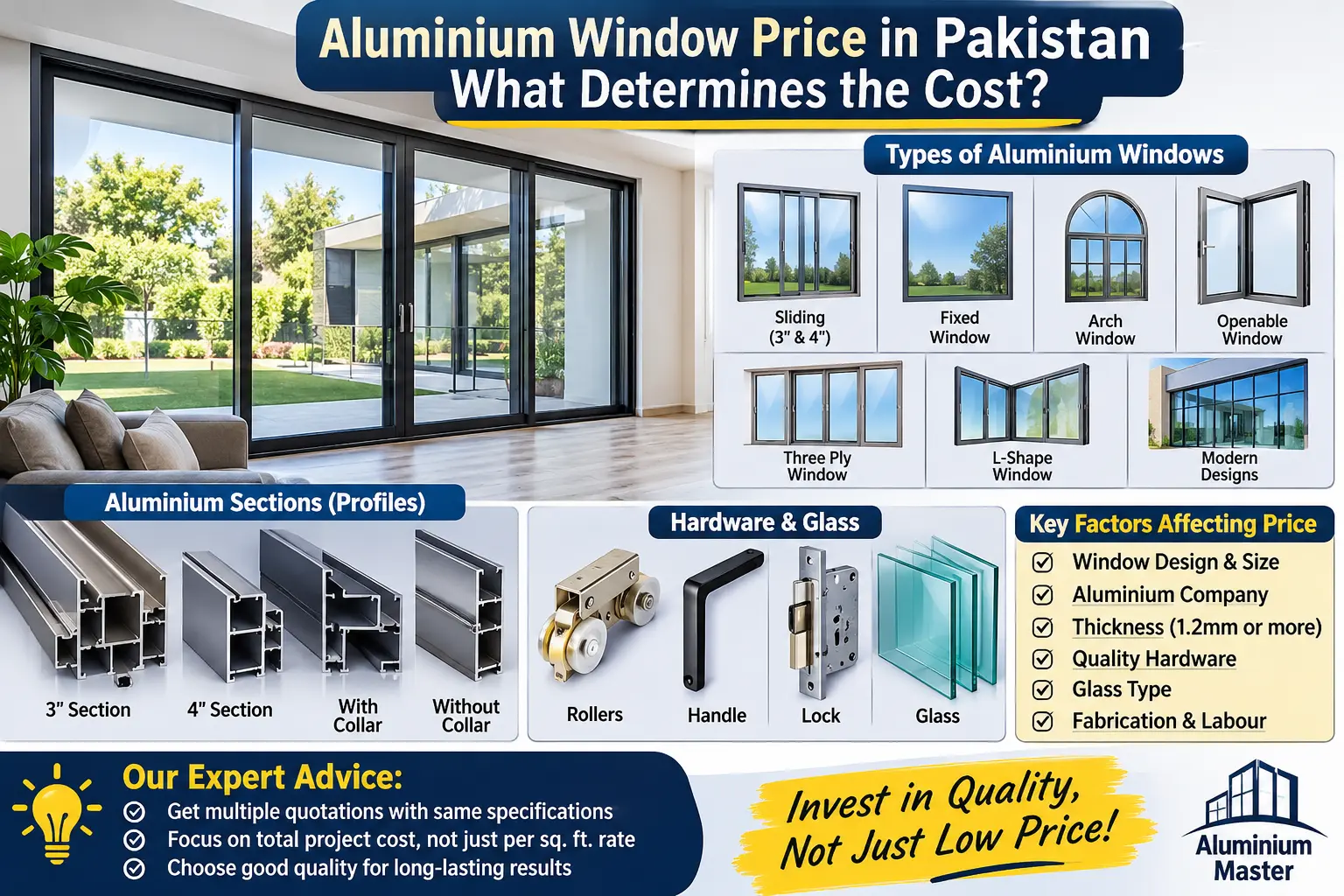
Sliding windows are the most common choice for homes, but even these vary widely. They are available in 3-inch and 4-inch sizes, with or without a collar, and with different numbers of panels.
The market also offers fixed windows, arch windows, openable windows, three-ply windows and more modern designs such as L-shape windows.
Each of these is made differently and uses a different quantity of material. The same type of window can also be made with sections from different companies, in different thicknesses or gauges.
On top of that come the glass, hardware, rubber, other essential materials and the fabricator’s labour. Only when all of these costs are added together do you get the real price of a particular window.
How to Get an Accurate Price for Your Project
If you want windows for your whole house, start by preparing the measurements and design details.
If you have architectural drawings, take them to a reliable aluminium shop or fabricator. If you don’t, ask an experienced fabricator to take measurements on site, then finalise the design according to your needs.
Sit down with the shopkeeper and settle these points:
- What type of windows do you need?
- What will the design and size be?
- Which company’s aluminium will be used?
- What will the section thickness be?
- What colour will the windows be?
- What type of glass and hardware will be used?
Once these details are agreed, ask for a written quotation for the entire project. This shows you the real cost of the complete job, not just a rough per square foot rate.
Three Things to Check in Every Quotation
Asking for the price is not enough. You should also know what materials that price includes.
1. Aluminium Company and Quality
Pakistan has many aluminium manufacturers and brands, and their quality, sections and prices can differ. Always ask which company’s aluminium will be used in your project.
2. Aluminium Thickness (Gauge)
Section thickness plays a major role in the strength and durability of a window. My personal advice is to avoid anything below 1.2mm for residential windows. That said, the right thickness also depends on the structure of the section and the design of the window.
Don’t rely on a verbal promise. Verify the thickness of the section being used.
3. Hardware Quality
Rollers, locks and handles may look like small items, but they have a big effect on how a window performs every day.
Low-quality rollers or locks can start causing problems after a while. Choose hardware of suitable quality, and make sure its details are written in the quotation.
One Mistake to Avoid When Comparing Shops
Getting quotations from two, three or four shops is a good decision. It gives you a clear idea of the prices and quality available in the market.
There is one thing to be careful about, though.
Suppose the first shop quotes you for a specific company’s aluminium, 1.2mm thickness, good quality hardware and a particular glass. When you go to the second shop, ask for a price on exactly the same details.
If the second shop uses a different company’s aluminium, a thinner section or lower-quality hardware, its price will naturally differ. Simply noting that one shop is cheaper and the other more expensive is not a fair comparison.
A real comparison is only possible when both quotations cover the same material, design and standard of work.
So do collect prices from different fabricators, but give each of them the same specifications.
Is the Per Square Foot Rate the Real Price?
Customers often give this question more attention than it deserves.
The per square foot rate is an easy way to estimate cost, but it is not enough to understand the cost of a whole project.
Here is a simple example. Suppose a large window measures 42 square feet and uses hardware worth Rs. 2,000. A small window measures only 9 square feet, yet it also uses about Rs. 2,000 of hardware.
If we divide the hardware cost by the area:
- 42 sq ft window: 2,000 ÷ 42 = about Rs. 47.62 per square foot
- 9 sq ft window: 2,000 ÷ 9 = about Rs. 222.22 per square foot
The total hardware cost is the same, but its effect per square foot is very different.
This happens because some costs, especially hardware and certain fabrication costs, do not rise or fall in proportion to the size of the window.
That is why large and small windows in the same project can have different per square foot rates.
In my opinion, you should focus on the total cost of your project, not the rate of a single window. In the end, you are getting all of your windows made and installed. The real questions are how much the complete project will cost and what quality of work you are getting for that price.
Can You Get the Best Quality at the Lowest Price?
Every customer wants good work at a reasonable price, and that is completely natural. With aluminium windows, however, the lowest price should not be your only measure.
Aluminium sections, glass and hardware that look alike can differ greatly in quality. Two shopkeepers may quote for the same window design while using quite different materials.
Good aluminium, proper thickness, quality hardware and careful fabrication all have a cost. A window made from lower-quality material may be cheaper, but its performance and durability can suffer.
Remember too that a higher price does not always guarantee better quality. This is why it is important to check the details of the material and the work.
My advice is to stay out of the race for the lowest price and choose the best quality your budget allows. Aluminium windows stay with your home for many years, so quality should come first.
Final Thoughts: Look at the Quality of the Complete Job
If you are getting aluminium windows made for your home or commercial project, keep these points in mind:
- Finalise your window measurements and design first.
- Find out the aluminium company and the section thickness.
- Check the quality of the glass and hardware.
- Get quotations from two to four fabricators on the same specifications.
- Look at the cost of the whole project, not just the per square foot rate.
- Choose good quality at a fair price over the lowest price.
A smart customer is not the one who simply pays the least. A smart customer is the one who gets the right material, better workmanship and lasting work for their money.
This is also the aim of Aluminium Master: to bring accurate and useful information about the aluminium and glass industry to everyday customers, so they can make better, informed decisions when choosing aluminium windows for their home or business.